Extended reach
Delivering advanced medical logistics forward to the Point of Injury.
- Drone-deployable (Aegis variant, in development)
- Self and buddy aid without a medic present
- Reduced dependence on immediate medic access

When evacuation is delayed, sometimes for many hours, what reaches the Point of Injury determines what care is possible. ResCura Tactical brings guided protocols and configurable medical logistics to the last mile; the Aegis variant, in development, adds drone delivery.
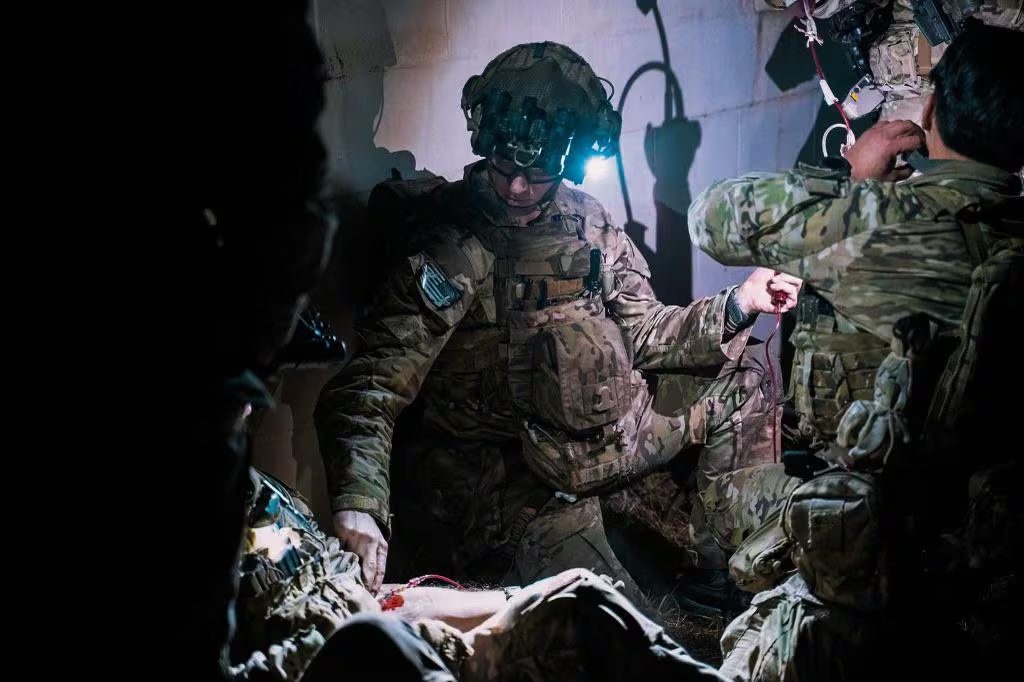

In large-scale combat operations and major civil disasters, the medical chain fails where it matters most: between the Point of Injury and definitive care. Air superiority is contested, roads are cut, drones saturate the airspace and the signal is jammed.
When helicopters cannot fly and ambulances cannot approach, evacuation can stretch well beyond doctrinal timelines, in some scenarios to 24 hours or more. Prolonged casualty care then becomes a realistic requirement.
Haemorrhage control, airway management and early resuscitation are time-critical. The kit's screen activates on opening and sequences these first steps for the responder immediately.
Electronic warfare means live telemedicine cannot be assumed. Guidance has to work on the kit itself, with no uplink at all.
The first person on scene is a buddy, a soldier or a volunteer with limited medical training. They need to act correctly, in the right order, under pressure.
Timeline adapted from NATO AJMedP-1 and JTS prolonged casualty care guidance. In contested environments the distance between Point of Injury and a medical facility may be short, yet evacuation may still take many hours.
Five timed, documented steps from casualty event to extended care. Steps 1–3 with the Field kit today; steps 4–5 with the Aegis variant in development.

A CE-marked Class I medical device that combines a configurable trauma kit with an integrated guided-response display. Built on the ResCura Smart Medikit platform and configured for the tactical and civil-protection setting.
Bringing advanced medical capability to the Point of Injury rests on three things: reach, guidance and sustainment.
Delivering advanced medical logistics forward to the Point of Injury.
Supporting medical decisions throughout casualty care.
Supporting care until definitive treatment.
One form, one reply from the defence team within two working days. Prefer e-mail or phone? Both are listed next to the form.